Macula SDK — RPC Guide
View SourceRequest/response over the mesh: advertise a handler, call a procedure, get a result.
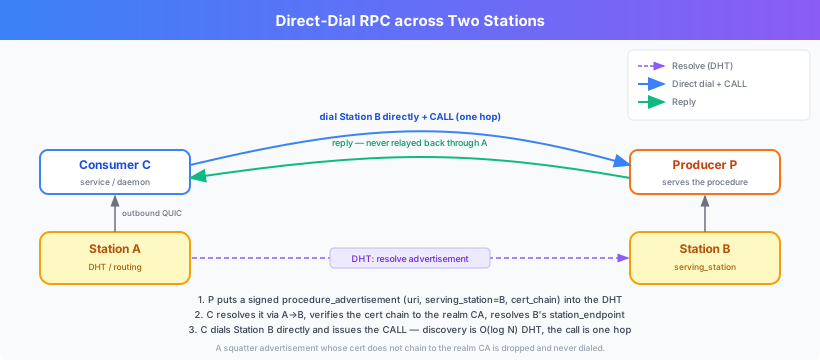
Audience: applications that need a request/response call to a specific procedure, as opposed to a broadcast (PubSub Guide) or an open-ended feed (Streaming Guide). Building something the wrapper below doesn't fit (custom retry logic, observability, an SDK for another language)? See RPC_PROTOCOL.md for the raw primitives this guide is built on.
Overview
A provider advertises a procedure with a handler; a consumer calls it
by name and gets a result back — macula_response and macula_request, an
addressable pid you can monitor and cancel, with rpc.*_v1 mesh facts
around every call.
Calling means resolving the procedure's provider and calling it in one hop.
The provider's signed procedure_advertisement in the DHT names its node_id
and the station it is connected to, and the call goes to that provider
through that station, bypassing your own pool's seeds entirely. A provider
is callable once its advertisement is published.
macula_request:start_link_direct/6,7,8, below, also takes options for that
resolution, such as the realm trust an org's procedures are checked against.
Supervised wrappers: macula_response / macula_request
advertise/5's handler runs in a transient process spawned per inbound
call, and call/5 blocks the calling process on its own gen_server:call
— neither has an addressable pid you can supervise, monitor, or cancel from
outside. macula_response and macula_request wrap the same two
primitives as proper OTP behaviours, and publish rpc.received_v1 /
rpc.replied_v1 (provider) or rpc.sent_v1 / rpc.completed_v1 (consumer)
mesh facts around each call — useful when something else on the mesh wants
to observe RPC traffic, not just participate in it.
Provider side — each inbound call starts one supervised child under a factory supervisor this module owns:
-module(math_service).
-behaviour(macula_response).
-export([init/1, handle_request/2]).

init(_Args) -> {ok, []}.

handle_request(#{<<"a">> := A, <<"b">> := B}, State) ->
{reply, A + B, State}.{ok, _Sup} = macula_response:advertise(Pool, Realm, Procedure,
math_service, []).Consumer side — start_link/6,7 returns immediately with a pid; the call
itself runs in a linked worker, and the outcome is delivered to
Module:handle_reply/2:
-module(add_caller).
-behaviour(macula_request).
-export([init/1, handle_reply/2]).

init(Parent) -> {ok, Parent}.

handle_reply(Result, Parent) ->
    Parent ! {add_result, Result},
{stop, normal, Parent}.{ok, Pid} = macula_request:start_link(add_caller, Pool, Realm, Procedure,
#{<<"a">> => 2, <<"b">> => 3},
5_000, self()).
%% cancel before a reply arrives — publishes rpc.completed_v1 with
%% outcome => cancelled
ok = macula_request:cancel(Pid).Embed macula_request_sup (a simple_one_for_one factory) in your own
supervision tree if you want to enumerate or cancel in-flight requests via
supervisor:which_children/1 / terminate_child/2 — that is what backs a
cancel_* RPC command in an application built on top of the SDK.
Direct-dial: start_link_direct / advertise_direct
The counterparts to start_link/6,7 and advertise/5,6 above, with the
same callback modules and the same behaviour. start_link/6,7 already
resolves and dials the provider's station directly, through macula:call/5;
start_link_direct also takes options for that resolution.
advertise_direct publishes the advertisement a caller resolves. See
RPC_PROTOCOL.md for the full trust-model writeup
(signature verification, station-endpoint resolution, why the TLS cert
itself stays unpinned).
Provider — advertise_direct/6,7 does everything advertise/5,6 does, and
additionally publishes a signed procedure_advertisement naming this pool's
connected station as the server, so a direct-dial consumer can find it:
%% NodeIdentity must be the node identity key this pool was started with: a
%% caller targets the node_id that signed the advertisement, and the station
%% knows this pool's connection by that node_id.
{ok, _Sup} = macula_response:advertise_direct(Pool, Realm, Procedure,
                                              math_service, [], NodeIdentity).
Consumer — start_link_direct/6,7,8 resolves the advertisement, resolves
and verifies the serving station's endpoint, and dials it in one hop:
{ok, Pid} = macula_request:start_link_direct(add_caller, Pool, Realm, Procedure,
                                             #{<<"a">> => 2, <<"b">> => 3},
                                             5_000, self()).
Resolve failures are distinguishable from call failures:
{error, {unresolved, Reason}} means nobody has advertised the procedure via
direct-dial yet (or the DHT record hasn't replicated to your station), not
that the call itself failed. Requires the provider to have advertised via
advertise_direct/6,7, not plain advertise/5,6 — a plain advertise
publishes no discoverable record.
For a procedure with an org namespace, resolution also checks the provider's
authorization, the org directory and the procedure delegation, against the
realm key your pool pinned for the realm when it started, from
macula:connect/2's realm_trust => #{RealmId => RealmKey}. The provider publishes its
authorization with macula_response:advertise_direct/7's authorization
option. 11.0.0 has no certificate form. Without the realm key, an
advertisement for an org namespaced procedure is never trusted. The 10.x
options verify_cert_chain and
cert_chain, and realm_trust on a call, are refused with
{error, {removed_option, Key}}. See
RPC_PROTOCOL.md.
Errors
handle_reply/2's Result is the same {ok, Value} | {error, Reason} shape
a raw call/5 returns — the wrapper doesn't change the outcome, only how you
receive it:
handle_reply({ok, Value}, Parent) ->
    Parent ! {add_result, Value},
    {stop, normal, Parent};
handle_reply({error, {call_error, Code, Detail}}, Parent) ->
    %% refused with a code: see RPC_PROTOCOL.md's Errors section
    logger:warning("RPC refused: ~p ~p", [Code, Detail]),
    {stop, normal, Parent};
handle_reply({error, Detail}, Parent) ->
    %% the handler returned {error, Detail}, or the call failed
    logger:warning("RPC failed: ~p", [Detail]),
    {stop, normal, Parent}.
{error, Detail} is the handler answering with an error. Detail is the
handler's own text when it returned a binary or a printable charlist, up to
256 bytes of it, and otherwise the name of its reason, such as
<<"refused">>. A handler's error text is sent to its caller as it is, so a
provider returns only text meant for the caller.
{error, {call_error, Code, Detail}} is a refusal with a code. It is either
the provider's own code, a binary, or unknown_next_peer from the station
when it holds no connection to the provider. See
RPC_PROTOCOL.md for every error a call returns.
Procedure naming
See the Topic Naming Guide — RPC procedures and
pub/sub topics share the same canonical format, built via macula_topic,
never inline strings.
See also
- RPC_PROTOCOL.md — the raw primitives underneath, every error a call returns, direct-dial trust-model internals.
- Streaming Guide — when one request/response isn't enough: a live feed, an upload, a duplex session.
- Authorization Guide — gating a procedure with
{ucan_required, Issuer}and calling it with a UCAN token minted for the calling identity. - Records Guide — the DHT record primitive
procedure_advertisementis built on. macula_response/macula_request— supervised, fact-announcing wrappers aroundadvertise/5andcall/5.