Macula SDK — Pub/Sub Guide
View SourceTopic-based messaging over the relay mesh.
Audience: Erlang/OTP applications publishing or subscribing to events. Building something the wrappers below don't fit? See PUBSUB_PROTOCOL.md for the raw
macula:subscribe/4,5/macula:publish/4,5primitives underneath.
Overview
A subscriber subscribes to a topic and receives every matching event; a
publisher publishes an event to a topic — macula_subscriber and
macula_publisher, an addressable pid you can monitor and cancel.
Subscribing and publishing are independent capabilities, unlike RPC's
request/response or a single content transfer — an application might do
only one, the other, or both. Every operation on either side names an
explicit realm and topic; see Three core ideas, below,
before writing your first macula_topic:app_fact/6 call.
See Supervised wrappers, right below.
Supervised wrappers: macula_subscriber / macula_publisher
macula:subscribe/4,5 delivers events as raw messages to whatever pid you
pass it, and macula:publish/4,5 is a plain blocking call — neither has an
addressable pid you can supervise, monitor, or cancel from outside.
macula_subscriber and macula_publisher wrap the same two primitives as
proper OTP behaviours. Only the publish side announces itself on the mesh —
macula_publisher publishes pubsub.publish_started_v1 /
pubsub.publish_completed_v1 around each transfer; macula_subscriber has
no mesh-fact equivalent, since a subscription has no single "done" moment to
announce.
Subscriber side — start_link/5,6 opens the subscription in its own
init/1 and threads macula_event / macula_event_gone dispatch into
Module:handle_event/4 for you — no hand-rolled handle_info clauses
needed (see PUBSUB_PROTOCOL.md
for the manual pattern this replaces, if you're building something the
wrapper doesn't fit). handle_event/4 receives Topic, Payload, and
Meta — a map carrying delivery context:
| Key | Type | Meaning |
|---|---|---|
realm | <<_:256>> | Realm tag (matches the subscribe call) |
publisher | <<_:256>> | The publisher's node_id (the original publisher, not the relay) |
seq | non_neg_integer() | Per-publisher monotonic sequence |
published_at | non_neg_integer() | When the publisher published it, in milliseconds since the epoch |
delivered_via | plumtree | direct | How this copy reached the station link |
publication_hash | <<_:384>> | SHA-384 of the publication's signed tbs; the pool delivers each hash once |
expires_at | non_neg_integer() | The last moment, in milliseconds, a verifier accepts the publication |
-module(my_orders_listener).
-behaviour(macula_subscriber).
-export([init/1, handle_event/4]).

init(_Args) -> {ok, #{}}.

handle_event(_Topic, Payload, _Meta, State) ->
    on_order_placed(Payload),
    {noreply, State}.
Topic = macula_topic:app_fact(Realm, my_org, my_app,
<<"orders">>, <<"placed">>, 1),
{ok, Pid} = macula_subscriber:start_link(my_orders_listener, Pool, Realm,
Topic, []).Opts (the arity-6 start_link/6) passes straight through to
macula:subscribe/5 — the delivery option covered in
Delivery ordering, below, works exactly the same way
whether you call it raw or through the wrapper.
A macula_event_gone for this subscription stops the sink with that reason
(see When the subscription ends, below). To
stop receiving events deliberately, stop the sink itself
(gen_server:stop/1, or let its supervisor terminate it) — the pool
monitors the subscriber pid directly and drops the wire-level subscription
automatically once it's gone, the same cleanup an explicit unsubscribe
gives a raw caller.
Publisher side — start_link/5,6 returns immediately with a pid; the
publish runs in a linked worker and the outcome reaches
Module:handle_published/2:
-module(status_publisher).
-behaviour(macula_publisher).
-export([init/1, handle_published/2]).

init(Parent) -> {ok, Parent}.

handle_published(Result, Parent) ->
    Parent ! {published, Result},
{stop, normal, Parent}.{ok, Pid} = macula_publisher:start_link(status_publisher, Pool, Realm,
Topic, Payload, self()).Result | Meaning |
|---|---|
ok | At least one link accepted the PUBLISH frame |
{error, {transient, no_healthy_station}} | The pool has zero spawned links — caller may retry |
{error, _} | Other failures (validation, etc.) |
Partial success counts as success. With
replication_factor > 1, the publish resolves as soon as the first selected link accepts the frame. Subsequent links are best-effort.
macula_publisher:cancel/1 stops it before the publish resolves,
delivering outcome => cancelled in the pubsub.publish_completed_v1
mesh fact — same shape as macula_feeder's sharing.put_started_v1 /
sharing.put_completed_v1.
Unlike macula_subscriber, macula_publisher:start_link/6's last argument
is Args (for Module:init/1) — there's no way to pass macula:publish/5's
own Opts (e.g. timeout_ms) through the wrapper. See
PUBSUB_PROTOCOL.md if you
need that.
Three core ideas
1. Realm-per-call
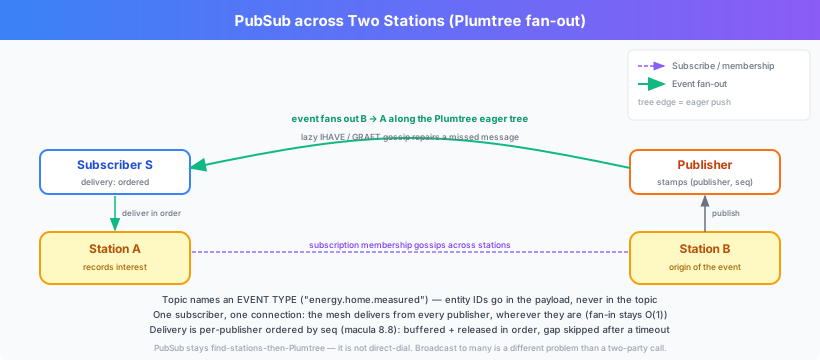
Every publish and every subscribe carries an explicit 32-byte realm tag. There is no connect-time default realm. Realms are how the mesh isolates traffic — a subscriber on Realm A never receives an event published to Realm B, even if the topic strings match exactly.
%% Same topic, different realms — totally separate streams.
ok = macula:publish(Pool, RealmA, Topic, PayloadA),
ok = macula:publish(Pool, RealmB, Topic, PayloadB).
Realms are 32-byte binaries. Use macula_realm:id/1 (SHA-256 of the
human-readable realm name) or your own realm registry to derive them.
2. Topics describe event types, not entities
Non-negotiable for scalable pub/sub.
Topic   = WHAT happened (event type, immutable)
Payload = WHO/WHERE/WHEN it happened (entity details)| Approach | 1M sensors | Topics | Result |
|---|---|---|---|
| ID in topic | 1M sensors | 1M topics | DHT explosion, memory exhaustion |
| ID in payload | 1M sensors | 1 topic | Scalable, efficient routing |
Wrong (topic explosion):
%% DO NOT DO THIS — entity ID baked into topic
Topic = macula_topic:app_fact(Realm, Org, App,
                              <<"weather">>,
                              <<"manchester_main_street_wind_measured">>, 1),
macula:publish(Pool, Realm, Topic, #{speed => 42.5}).
Right (IDs in payload):
Topic = macula_topic:app_fact(Realm, Org, App,
                              <<"weather">>, <<"wind_measured">>, 1),
macula:publish(Pool, Realm, Topic, #{
    station_id => <<"manchester-main-street">>,
    speed => 42.5,
    unit => <<"km/h">>,
    timestamp => erlang:system_time(millisecond)
}).
3. Topics are built — never hand-typed
%% Always
Topic = macula_topic:app_fact(Realm, Org, App, Domain, Name, Version),

%% Never
Topic = <<"my.realm/my.org/my.app/orders/placed_v1">>.
macula_topic returns a canonical binary that the SDK and stations
agree on. Nothing on the send path rejects a hand-rolled string —
macula:publish/4,5 and subscribe/4,5 take Topic as an opaque
binary and send whatever you pass, so a typo just never matches
instead of erroring. Building via macula_topic turns that class of
bug into a wrong value your own tests can catch. See
Validation in the Topic
Naming Guide for exactly what is and isn't enforced.
See TOPIC_NAMING_GUIDE.md for the canonical
specification of the five-segment shape and the realm_fact / org_fact / app_fact tier choice.
When the subscription ends
The only way a live subscription produces a terminal message today is
the pool closing — delivered to handle_event/4's raw equivalent as
{macula_event_gone, SubRef, pool_closed}, and to a macula_subscriber
sink as its own termination with that reason.
A link dying does not end the subscription — the pool logs
_macula.client.link_down, schedules a respawn, and silently
re-issues the subscription against the new link once it's up (see
Connecting Guide). Neither layer
sees a gap-signaling message for that case, only a possible gap in
delivery itself, which ordered mode's order_timeout_ms skip
handles the same way it handles any other loss.
After the subscription ends, no further events come for it.
Delivery ordering
The delivery option chooses how a single publisher's stream is
ordered on the way to your subscriber — pass it in Opts to
macula_subscriber:start_link/6 the same way you would to raw
macula:subscribe/5. This matters because the mesh sends copies of a
fact down several links at once, and the pool dedups to the first
arrival — so without ordering, a single publisher's seq 1, 2, 3 can
reach you as 1, 3, 2. Each publisher's seq is pool-monotonic and
contiguous, which is exactly what makes ordered delivery possible.
| Mode | Behaviour | Use when |
|---|---|---|
ordered (default) | Per-publisher FIFO by seq. Out-of-order arrivals are buffered and released in order; a genuinely missing seq is skipped after order_timeout_ms. | Event / delta streams where order matters. |
latest_only | Deliver only seqs newer than the highest seen for that publisher (drop stale). No buffering, no head-of-line delay. | State snapshots — you want the freshest value, not every value. |
as_arrives | Raw arrival order. Zero added latency; you order it yourself. | You have your own versioning, or you truly do not care. |
Ordering state is kept per publisher, and separately for EVENTs whose publisher signature verified and for all others: unsigned EVENTs are ordered among themselves, per publisher, and never affect the order of a verified publisher's EVENTs.
%% default — per-publisher FIFO
{ok, Pid1} = macula_subscriber:start_link(my_orders_listener, Pool, Realm, Topic, []),

%% newest-wins, drop stale
{ok, Pid2} = macula_subscriber:start_link(my_orders_listener, Pool, Realm, Topic, [],
                                          #{delivery => latest_only}),

%% raw arrival order (the pre-8.8 behaviour)
{ok, Pid3} = macula_subscriber:start_link(my_orders_listener, Pool, Realm, Topic, [],
                                          #{delivery => as_arrives}).
Ordered mode and loss. ordered trades a bounded delay for order:
if seq 2 never arrives, the buffer holds 3, 4, … only until
order_timeout_ms elapses, then skips the gap and releases them. That
skip is the accepted "order-not-guaranteed delivery" trade for a lost
fact — a reorder buffer cannot invent a message the mesh dropped. Design
mesh facts to be idempotent and version-stamped so an occasional
skip washes out.
A publisher's first facts. When an ordered subscription first hears
from a publisher, or hears from it again after a restart, it does not yet
know where that publisher's order starts: copies arrive over several links
in any order. It holds that publisher's first facts for up to
order_timeout_ms (or until order_max_buffer facts are held), then starts
the order at the lowest seq it has seen, so a lower seq that arrives after a
higher one is still delivered, in order. A publisher's first facts therefore
reach the subscriber up to one order timeout later than its later facts.
Publisher restarts. A publisher's seq is seeded from wall-clock
microseconds at start (macula_client for an SDK pool; hecate_pubsub_server
for a station's own facts, since 10.17.0), so a restart shows up as a jump
far wider than any reorder window. Both ordered and latest_only read a
jump of more than 10 000 in either direction as a new epoch: the old
epoch's buffered tail is released, then delivery continues from the new
counter. The backward case matters for any publisher whose counter restarts
at 0: without it, every fact after such a restart is dropped as "already
delivered" until the counter climbs back over the old watermark, with
nothing in macula:status/1 showing it (a live read model went blind for
10+ hours this way in September 2026). A backstep smaller than that is still
a late duplicate and is still dropped.
Total order is not offered, by design. ordered restores a single
publisher's order (cheap, over ordered transport). It does not impose a
total order across different publishers — that would need a single
sequencer (a consensus log) that the mesh deliberately does not have.
Cross-publisher order is not something a decentralised broadcast can give
you; carry a version or timestamp in the fact if a consumer needs to
relate two publishers' events.
Pool-level tuning (connect/2 options)
| Option | Default | Meaning |
|---|---|---|
order_timeout_ms | 250 | How long an ordered sub waits for a missing seq before skipping the gap, and the longest it holds a new publisher's first facts. Bounds head-of-line delay. |
order_max_buffer | 1024 | Per-publisher reorder-buffer count cap. Over it, the head gap is skipped early (memory guard for a high-rate publisher gapping). |
Telemetry — is loss real?
macula:status/1 reports pubsub_gap_skips: the number of per-publisher
gaps given up on after the timeout, i.e. the genuine loss rate an
ordered subscriber could not fill. A near-zero value means the mesh is
delivering and ordered costs you almost nothing; a rising value is the
signal to look at delivery, not ordering.
{ok, #{pubsub_gap_skips := Skips}} = macula:status(Pool).Dedup and delivery guarantees
Every EVENT's publication is verified before delivery, and one that does
not verify is dropped. The dedup key is the publication's hash, the SHA-384
of its signed tbs: the pool guarantees you see each publication at most
once, even when it arrives via multiple links (e.g. with
replication_factor > 1). Two publications that share a realm, publisher
and seq are still two publications, with two hashes. In
ordered and latest_only modes the delivery layer additionally uses the
seq to order or drop; in as_arrives the dedup layer is the only filter.
- At-most-once — fire and forget. No publisher-visible ack from subscribers.
- Per-publisher delivery order —
orderedby default at the subscriber (see Delivery ordering above): out-of-order arrivals are buffered and released inseqorder, with a genuinely missingseqskipped afterorder_timeout_ms. The mesh itself does not guarantee arrival order — a relay spreads one publisher's burst across concurrent verify workers, and a receiver may admit an event by more than one path — the subscriber-sideorderedbuffer is what turns that into in-order delivery. Opt intoas_arrivesif you'd rather see raw arrival order and reorder yourself. - Cross-publisher ordering — none, by design. Two publishers' events arrive in arbitrary interleaving; see "Total order is not offered, by design" above.
- Cross-link dedup: the pool dedupes by publication hash and keeps
each hash until the publication expires,
published_atplus itsttl_ms(at most 1 hour), or 10 minutes without one, plus 5 minutes, after which every verifier refuses it. The pool judges expiry when an event arrives, and records a hash only while a subscription matches it. - Cross-station gossip — default since 4.5.0. A daemon connected to station A and a daemon connected to station B see each other's publishes once subscription interest and the fact itself have gossiped between the stations; every hop verifies a publication once, keyed by its hash, before it delivers or forwards it, which is what makes this safe past one hop.
Topic naming reference
Quick reference. Full specification: TOPIC_NAMING_GUIDE.md.
Every topic is exactly five slash-separated segments:
{realm}/{publisher_org}/{publisher_app}/{domain}/{name}_v{N}Pick a tier based on who owns the topic:
| Tier | Builder | Use when |
|---|---|---|
| Realm-level | macula_topic:realm_fact/4, macula_topic:realm_hope/4 | Topic owned by the realm itself |
| Org-level | macula_topic:org_fact/5, macula_topic:org_hope/5 | Topic owned by an organization within a realm |
| App-level | macula_topic:app_fact/6, macula_topic:app_hope/6 | Topic owned by an application within an organization |
Past tense for facts (order_placed, wind_measured, user_registered).
Present tense for hopes (order_place, payment_authorize).
System topics (_mesh.*, _macula.*) are infrastructure-owned and
dot-separated. Do not publish to them from app code.
Patterns
Re-subscribe after pool restart
If your supervisor restarts the pool, your subscribers are not automatically re-attached. Either:
- Restart your subscriber processes (or
macula_subscribersinks) alongside the pool (one supervisor withrest_for_onestrategy), or - Watch for the subscription ending with
pool_closedand re-subscribe to the new pool.
Multiple subscribers on one pool
A single pool can have arbitrarily many local subscribers — whether raw
processes or macula_subscriber sinks. The pool issues exactly one
wire-level SUBSCRIBE per (Realm, Topic), multiplexes inbound events to
every local subscriber for that pair, and dedupes across links.
Backpressure
Events are delivered as Erlang messages. If a subscriber is slow, its mailbox grows. The pool itself never blocks. Apply your usual mailbox-flow-control patterns (process throttling, batching, etc.).
Idempotent handlers
The pool delivers each publication at most once, and verifiers refuse a copy that arrives after the publication expired. A publisher that sends the same fact twice still makes two publications, so make handlers idempotent — match on a payload-level key (order id, sensor id + timestamp, etc.) when correctness matters.
Best practices
- IDs in payloads, not topics. Always.
- Past-tense facts, present-tense hopes. No CRUD verbs
(
created,updated,deleted). - Build topics via
macula_topic— never inline strings. - Include a timestamp —
erlang:system_time(millisecond)in every payload. - Keep handlers fast — spawn workers for heavy processing.
- Make handlers idempotent: the pool delivers each publication once, but a publisher can send one fact as two publications; don't rely on exactly-once.
Diagnostics
| Event topic | When | Meta |
|---|---|---|
_macula.client.link_down | A pool link's worker died | seed, pid, reason |
_macula.peering.handshake_timeout | A station handshake hung past state_timeout | role, buf_size, has_stream, timeout_ms |
These come through macula_diagnostics:event/2; wire them into your
observability layer.
See also
- PUBSUB_PROTOCOL.md — the raw primitives underneath, plus how relay-side routing works.
- Connecting Guide — pool model, lifecycle, options
- Topic Naming Guide — canonical topic shape
- Authorization Guide — UCAN/DID identity
macula_pubsub— slice modulemacula_client— pool implementationmacula_subscriber— supervised subscriber behaviour