Macula SDK — Streaming Guide
View SourceStreaming RPC over the mesh: server-push, client-push, and bidirectional.
Audience: applications that need more than one request/response — a live feed of frames, an upload of many chunks, or a long-lived two-way exchange. Available since SDK 3.17. Building something the wrappers below don't fit? See STREAMING_PROTOCOL.md for the raw
call_stream/5/advertise_stream/5primitives underneath.
Overview
A plain macula:call/5 is one request and one reply. A streaming RPC keeps
the channel open so either side (or both) can send a sequence of chunks before a
final result. Each session gets its own dedicated QUIC stream, opened for that
session alone — not multiplexed onto the connection's shared control stream the
way an ordinary CALL or a PUBLISH is — so QUIC's own per-stream flow control
paces the sender to the receiver, and a slow or stalled stream cannot
head-of-line-block other RPC/PubSub traffic on the same connection.
There are three modes:
| Mode | Who streams | Typical use |
|---|---|---|
server_stream | provider pushes many chunks, consumer reads | content streaming — a live feed, a query that yields many rows |
client_stream | consumer pushes many chunks, provider reads | an upload, a batch submit |
bidi | both push concurrently | an interactive session, a duplex protocol |
A stream is a pid(). It is sticky to one link: if that link dies you get
{error, peer_down} and re-open.
Two layers can drive any of this, and most applications want the supervised
one — an addressable pid you can monitor and cancel, streaming.*_v1 mesh
facts around each session: see
Supervised wrappers,
right below.
Supervised wrappers: macula_streamer / macula_stream_sink
The bare handler fun and the raw stream pid (both covered in
STREAMING_PROTOCOL.md) run per inbound STREAM_OPEN or
require a hand-written recv/2 loop, with no addressable pid you can
supervise, monitor, or cancel from outside. macula_streamer and
macula_stream_sink wrap the same two primitives as proper OTP behaviours,
and each publishes its own streaming.started_v1 / streaming.completed_v1
mesh fact — from its own side's perspective, not deduplicated against the
other side's copy.
Provider side — each inbound stream starts one supervised child under a
factory supervisor this module owns. The child takes its stream over, so the
stream ends with the child, and the child stops when the stream's session ends
(the consumer closed, aborted, or its link went), whether or not your module
would stop by itself. Sending is push-based: once
handle_open/2 has stashed self() somewhere discoverable (a registry, an
ETS table, a message to a known process), any code holding that pid can
call macula_streamer:send/2,3 and close/1 on it from outside:
-module(log_tailer_provider).
-behaviour(macula_streamer).
-export([init/1, handle_open/2]).

init(Registry) -> {ok, Registry}.

handle_open(#{<<"topic">> := Topic}, Registry) ->
    Registry ! {tailer_ready, Topic, self()},
{ok, Registry}.{ok, _Sup} = macula_streamer:advertise(Pool, Realm, <<"logs.tail">>,
log_tailer_provider, self()).
%% elsewhere, once the provider has announced its pid:
ok = macula_streamer:send(TailerPid, <<"a log line\n">>).Consumer side — start_link/5,6 opens the stream and drives the recv/2
loop in a linked reader process, delivering each chunk to
Module:handle_chunk/2:
-module(log_tailer).
-behaviour(macula_stream_sink).
-export([init/1, handle_chunk/2, handle_close/2]).

init(_Args) -> {ok, []}.

handle_chunk(Line, Lines) ->
    io:format("~s", [Line]),
    {noreply, [Line | Lines]}.

handle_close(_Reason, _Lines) -> ok.{ok, Pid} = macula_stream_sink:start_link(log_tailer, Pool, Realm,
<<"logs.tail">>, []).start_link/7 and start_link_direct/7 take start options. stream_io
gives the functions a sink opens, reads and ends its stream with:
call_stream/5, recv/2, close_stream/1 and abort/3, checked by
macula_stream:stream_io/2. fact_publish gives the function it announces
its facts with. Without them they are the macula facade's, and a
direct-dial sink dials with macula_direct_dial:call_stream/5. A test can
run a sink this way on a scripted stream without replacing macula.
client_stream providers get the mirror-image receive loop. Export the
same optional handle_chunk/2 callback on the PROVIDER-side module and
macula_streamer drives a linked-reader loop against its own stream,
symmetric to macula_stream_sink's consumer-side one. A server_stream
module that doesn't export it is unaffected — the reader is only spawned
when the callback is present.
macula_streamer:advertise/6 and advertise_direct/7 take the functions a
streamer runs on in their options: advertise_stream, publish_advertisement,
fact_publish, and stream_io with the seven stream functions
macula_stream:stream_io/2 checks. macula_upload passes them on. A test can
advertise a provider this way on a scripted stream without replacing macula
or macula_stream.
-module(batch_upload_provider).
-behaviour(macula_streamer).
-export([init/1, handle_open/2, handle_chunk/2]).

init(Parent) -> {ok, {Parent, []}}.

handle_open(_StreamArgs, State) -> {ok, State}.

handle_chunk(Chunk, {Parent, Acc}) ->
{noreply, {Parent, [Chunk | Acc]}}.{ok, _Sup} = macula_streamer:advertise(Pool, Realm, <<"bulk.ingest">>,
batch_upload_provider, self(),
#{mode => client_stream}).Cancel. Stopping either wrapper for a non-normal reason (a crash, a
recv error, a callback returning a non-normal stop) sends the peer an
explicit macula_stream:abort/3 STREAM_ERROR instead of an ordinary close
or a silent link-crash — the peer can tell a genuine cancellation/failure
from a clean end-of-stream. A normal stop closes both sides cleanly, same
as before.
Direct-dial: advertise_direct / start_link_direct
The direct-dial counterparts — resolve the procedure's
procedure_advertisement from the DHT and dial the serving station in one
hop, instead of routing through the pool's existing links. A
procedure_advertisement does not distinguish RPC from streaming, so this
is the exact same resolve-and-trust mechanism as RPC direct-dial —
see that guide for the full trust-model writeup.
Provider — advertise_direct/6,7 does everything advertise/5,6 does, and
additionally publishes the discoverable record:
Identity = macula_identity:generate(),
{ok, _Sup} = macula_streamer:advertise_direct(Pool, Realm, <<"logs.tail">>,
                                              log_tailer_provider, self(),
                                              Identity).
Consumer — start_link_direct/5,6 resolves and dials in one hop:
{ok, Pid} = macula_stream_sink:start_link_direct(log_tailer, Pool, Realm,
                                                 <<"logs.tail">>, []).
Requires the provider to have advertised via advertise_direct/6,7, not
plain advertise/5,6 — a plain advertise publishes no discoverable record.
Gating a stream procedure
A stream procedure can require a token the same way a unary one can. Give
macula_streamer:advertise/6 (or advertise_direct/7) an auth policy in
Opts, and consumers pass ucan_token in their call_stream opts. See the
Authorization Guide for the policies.
Content streaming
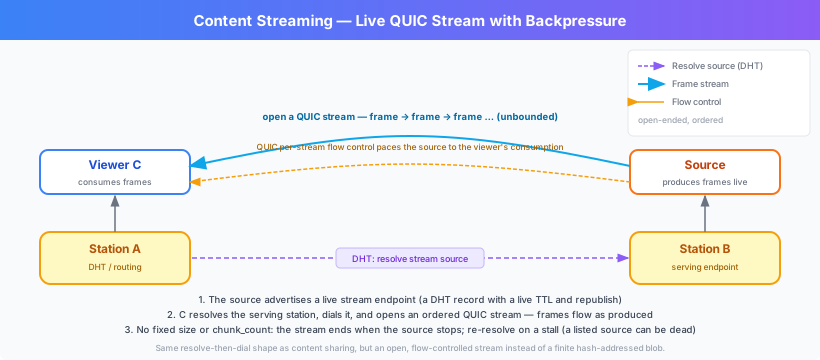
"Content streaming" is the server_stream mode applied to a live source: the
provider advertises the stream procedure and its procedure_advertisement in the
DHT; a viewer resolves it, dials the serving station directly with
call_stream_station (see STREAMING_PROTOCOL.md), and
reads frames until the source stops. Unlike content sharing
there is no fixed size or chunk_count — the stream is open-ended and
ordered, riding its own dedicated QUIC stream (see Overview above), and
QUIC's per-stream flow control paces the source to the viewer's consumption
without contending with anything else on the connection.
Freshness is not optional. A live source can go away. Treat a recv stall or
{error, peer_down} as a signal to re-resolve the source and re-open, exactly
as a direct-dial caller re-resolves on a dial failure.
Reference
| Function | Role |
|---|---|
macula_streamer:advertise/5,6 | provider: supervised, streaming.*_v1-announcing wrapper. Optional Module:handle_chunk/2 drives a receive loop for client_stream mode; optional Module:handle_eof/1 sets the terminal reply; abort-wired cancel |
macula_streamer:advertise_direct/6,7 | provider: as above, and publishes a procedure_advertisement for direct-dial |
macula_stream_sink:start_link/5,6 | consumer: supervised, streaming.*_v1-announcing wrapper; abort-wired cancel |
macula_stream_sink:start_link_direct/5,6 | consumer: direct-dial — resolve the provider and dial in one hop |
For a targeted push at a specific known recipient instead of an open-ended
feed, see Push/upload
in the Content Guide (macula_pusher/macula_upload — client_stream mode
with content-integrity checking bolted on).
See STREAMING_PROTOCOL.md's Reference for the raw primitives these wrap, and for local in-process streams (unit tests, same-node dispatch).
See also
- STREAMING_PROTOCOL.md — the raw primitives
underneath:
call_stream/advertise_stream,send/recv, local in-process streams. - Content Guide — content-addressed blob
storage, and
macula_pusher/macula_uploadfor a targeted push. - RPC Guide — the same direct-dial trust model, applied to request/response instead of streaming.
macula_streamer/macula_stream_sink— supervised, fact-announcing wrappers aroundadvertise_stream/5andcall_stream/5.