Macula SDK — Plumtree Guide
View SourceEpidemic broadcast trees, realm-scoped PubSub, and an OR-Set CRDT — all riding on HyParView's active view.
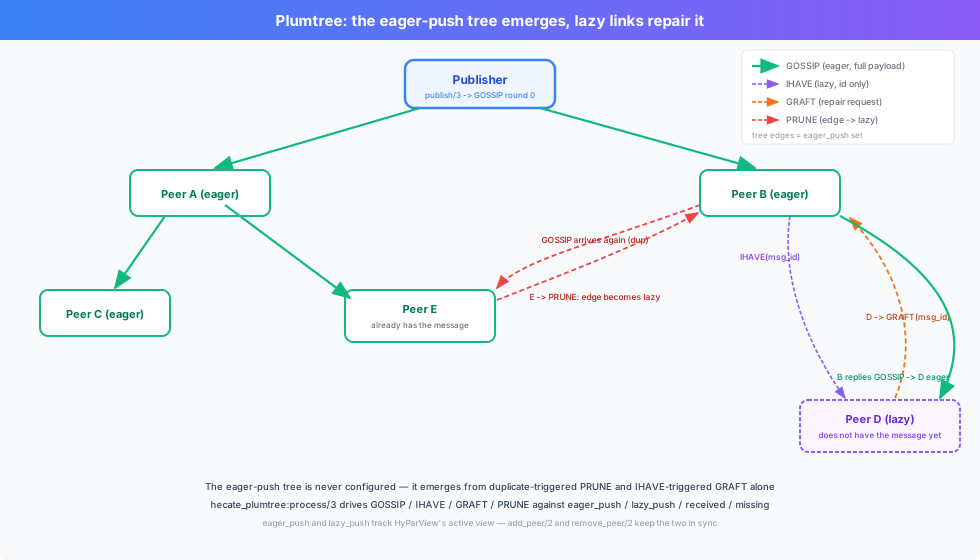
Audience: the same as HYPARVIEW_GUIDE.md — you're building a process that needs to flood a message to every member of a realm's overlay, or maintain realm-shared state that converges without coordination. If you just want ordinary application PubSub, use PUBSUB_GUIDE.md instead — it already rides on this exact machinery internally (see Realm PubSub, below), wrapped as a supervised OTP behaviour you don't have to drive by hand.
Overview
HyParView gives every realm member a small, bounded active view — a handful of live connections, not a connection to every other member. Flooding a message reliably over that sparse graph, without every node needing to know the graph's global shape, is a separate problem: naive flooding (forward to everyone, always) wastes bandwidth on duplicates; a fixed spanning tree is bandwidth-optimal but a single failed edge partitions the broadcast until something notices and repairs it.
Plumtree (Leitão, Pereira, Rodrigues, "Epidemic Broadcast Trees",
SRDS 2007) gets both: an eager-push spanning tree emerges from the
active view for the common case (one full copy per message, no
duplicates), backed by a lazy-push gossip layer that announces
IHAVE and grafts a missing branch back in within one round trip whenever
the tree is damaged. The tree isn't configured anywhere — it emerges purely
from which peers duplicate-detect a GOSSIP and prune themselves to lazy.
This SDK ships the pure protocol (hecate_plumtree) plus two small
capabilities built on top of it: realm-scoped PubSub (hecate_pubsub,
hecate_pubsub_server, hecate_pubsub_registry) and an OR-Set CRDT
(hecate_or_set) for realm-shared mutable state. All four are pure or
GenServer-wrapped state machines — none of them touch the network directly;
you drive hecate_plumtree the same way you drive macula_hyparview_proto,
over the overlay transport.
Eager push, lazy push, and how the tree heals
Every peer in hecate_plumtree's state is in exactly one of two sets:
| Set | Receives | Role |
|---|---|---|
eager_push | Full GOSSIP payloads | Is the spanning tree — these are the tree edges |
lazy_push | IHAVE announcements only (message id, no payload) | Backup path — grafts back to eager on demand |
State0 = hecate_plumtree:new(MyIdentity, Realm),
State1 = hecate_plumtree:add_peer(State0, PeerA),   %% starts eager — full GOSSIP
%% ... time passes, PeerA turns out to duplicate a GOSSIP it already had ...
The healing loop, end to end:
- Publish —
publish/3records the message locally, sendsGOSSIPto every eager peer andIHAVEto every lazy peer. - Receive GOSSIP, first time — deliver it, mark the sender eager (a
GOSSIPfrom a lazy peer means the tree just grew an edge), forwardGOSSIPto every other eager peer andIHAVEto every lazy peer. - Receive GOSSIP, duplicate — the sender is redundant on this
message's path;
PRUNEthem to lazy. This is what keeps the eager set converging to an actual tree instead of flooding forever. - Receive IHAVE for a message not yet seen — record the sender as a
candidate and
GRAFTback immediately, promoting them to eager. (A production deployment typically delays this briefly to let the eager push win the race first — this SDK's MVP grafts right away, which is correct, just slightly more eager than optimal.) - Receive GRAFT — promote the sender to eager and, if the message is
on hand, reply with the full
GOSSIP. - Receive PRUNE — demote the sender to lazy.
{State1, Actions, Deliveries} = hecate_plumtree:publish(State0, MsgId, Payload),
lists:foreach(fun({send, Peer, Frame}) -> send_to(Peer, Frame) end, Actions),
%% Deliveries == [{MsgId, Payload}] -- your own local copy, handle it here.

handle_info({macula_overlay_frame, _Ref, Frame, #{sender := From} = Meta}, State) ->
    Clocks = #{wall => erlang:system_time(millisecond), monotonic => erlang:monotonic_time(millisecond)},
    {PT1, Actions, Deliveries} = hecate_plumtree:process(State#state.plumtree, From, Frame, Clocks),
    lists:foreach(fun({send, Peer, F}) -> send_to(Peer, F);
                     ({refused, _Peer, Kind}) -> macula_station_link:overlay_frame_refused(State#state.link, Meta, Kind)
                  end, Actions),
    lists:foreach(fun({MsgId, Publication}) -> deliver_locally(MsgId, Publication) end, Deliveries),
    {noreply, State#state{plumtree = PT1}};
A frame a station relays arrives with via, the station that relayed it, in
its Meta. A GOSSIP goes to the subscriber of the realm its publication
claims, read without verifying, and hecate_plumtree:process/4 verifies the
publication before it delivers anything. So the Plumtree layer is the
subscriber that acts on plumtree frames, and no other overlay subscriber
should act on them unverified. Report each refusal with
macula_station_link:overlay_frame_refused/3 and the frame's Meta: a
refusal of what a relayed frame carries is counted on the link and never
charged to the station that relayed it.
MsgId is a caller-chosen 16-byte identifier — dedup and delivery tracking
key off it, so use something collision-resistant (a random token, or a
content hash if you want idempotent re-publish of the same payload to
converge to one delivery).
Wiring to HyParView: when the active view changes, tell Plumtree.
%% HyParView admitted a new active peer -> it becomes eager immediately.
Plumtree1 = hecate_plumtree:add_peer(Plumtree0, NewActivePeer),
%% HyParView evicted/disconnected a peer -> drop it from both push sets.
Plumtree2 = hecate_plumtree:remove_peer(Plumtree1, GonePeer).
Plumtree never asks HyParView anything directly — the wiring is your
dispatcher process reacting to macula_hyparview_proto:process/4's
Actions (a DISCONNECT sent means call remove_peer/2; a successful
NEIGHBOR/JOIN admission means call add_peer/2) and feeding the result
into hecate_plumtree.
Realm PubSub (hecate_pubsub)
A thin, realm-scoped topic index sits on top of Plumtree fan-out:
hecate_pubsub tracks topic => subscribers for one realm, converts a
publish into a signed EVENT frame, and matches an inbound EVENT against
local subscribers. hecate_pubsub_server activates it as a gen_server
(one process per realm), and hecate_pubsub_registry holds the
RealmTag => pid() map, spawn-linking a fresh server for a realm the first
time it's needed.
{ok, Registry} = hecate_pubsub_registry:start_link(#{identity => MyIdentity}),
{ok, ServerPid} = hecate_pubsub_registry:register(Registry, Realm, MyIdentity),

%% Local subscribe (no network round trip — subscription state is local;
%% Plumtree/OR-Set propagate WHO is subscribed where separately).
ok = hecate_pubsub_server:subscribe(ServerPid, <<"sensors.temperature">>, SubscriberPubkey),

%% Publish: builds the signed EVENT frame + returns matched LOCAL subscribers.
%% Fan-out to remote realm members is your dispatcher handing Frame to
%% hecate_plumtree:publish/3, keyed by a fresh MsgId.
{Frame, LocalSubs} = hecate_pubsub_server:publish(ServerPid, <<"sensors.temperature">>, Payload).
This is exactly the machinery macula_pubsub/macula_subscriber/
macula_publisher already ride on inside a station for ordinary
application PubSub (see PUBSUB_GUIDE.md) — the
station runs one hecate_pubsub_registry per identity and drives it from
its own listener. You'd reach for these modules directly only when building
a different realm-scoped dispatcher that needs the same primitive (for
example, a realm-membership service maintaining its own overlay separately
from the station's).
hecate_pubsub_registry's realm tags are opaque 32-byte namespaces — it
does not validate who's allowed to use a given tag. Authority (who may
subscribe, who may publish) is a layer above this, e.g. via
macula_hyparview_endorsement
gating who gets into the realm's active view in the first place.
OR-Set CRDT (hecate_or_set)
Realm-shared mutable state — a member list, a chat thread's participant
set, directory metadata — needs to converge across nodes without
coordination, including under concurrent add/remove. hecate_or_set is an
Observed-Remove Set: add/2 tags each element with a fresh random tag,
remove/2 tombstones every tag currently observed for that element. The
payoff: if Alice adds herself back to a group in the same instant Bob
removes her, the add wins — Bob's remove could only tombstone the tags he'd
actually seen.
Set0 = hecate_or_set:new(),
{Set1, AddDelta}    = hecate_or_set:add(Set0, <<"alice">>),
{Set2, RemoveDelta} = hecate_or_set:remove(Set1, <<"alice">>),
hecate_or_set:members(Set2).   %% => []

%% Gossip the delta over Plumtree instead of the whole set on every change:
{_, {send, Peer, Frame}} = {ok, plumtree_frame_for(AddDelta)},
%% ... on the receiving end ...
Set3 = hecate_or_set:apply_delta(RemoteSet, AddDelta).
Two convergence paths, both associative/commutative/idempotent so any
delivery order reaches the same final state: merge/2 for full-state
catch-up sync (e.g. a node rejoining after a partition), apply_delta/2
for the common case — one delta per Plumtree GOSSIP.
See also
- HyParView Guide — the active view Plumtree's eager push set is built from, and the overlay transport both ride on.
- PubSub Guide — the supervised, client-facing PubSub wrapper that already uses this machinery internally.
plans/PLAN_MACULA_V2_PART3_DISCOVERY.md§7.2 (Plumtree), §7.4 (OR-Set);plans/PLAN_MACULA_V2_PART6_PROTOCOL.md§6 (realm PubSub wire format).- Leitão, Pereira, Rodrigues, "Epidemic Broadcast Trees", SRDS 2007.
- Shapiro, Preguiça, Baquero, Zawirski, "A Comprehensive Study of
Convergent and Commutative Replicated Data Types", INRIA 2011 (the
OR-Set construction
hecate_or_setimplements).