Macula Clustering Guide
View SourceThis guide covers Macula's LAN clustering capabilities, including gossip-based discovery, the Cluster API, distribution management, and cookie management. The modules live in src/macula_cluster_system/, separate from src/macula_dist_system/ (distribution over the mesh). The two do not depend on each other.
Note: Clustering via gossip is designed for LAN environments (same subnet). For WAN connectivity across networks, use the relay mesh (see the Dist Over Mesh guide).
Overview
The Macula Cluster API (macula_cluster.erl) provides a standardized interface for:
- Cluster Formation - Starting clusters with various discovery strategies
- Distribution Management - Starting and verifying Erlang distribution
- Cookie Management - Resolving, setting, and persisting cluster cookies
- Node Monitoring - Subscribing to node join/leave events
Cluster Strategies
| Strategy | Discovery | Configuration | Network | Use Case |
|---|---|---|---|---|
| gossip | Automatic (UDP multicast) | Zero-config | LAN multicast | Development, same-subnet production |
| static | Manual | Node list required | Any | Known node sets, cross-subnet |
| auto | Static if nodes is set, else gossip | — | — | Let start_cluster/1 pick |
Any other strategy value returns {error, {unknown_strategy, Strategy}}
and does not start distribution. For zero-config discovery on a LAN use
gossip; otherwise use static with a node list.
Quick Start
Via macula_cluster API (Recommended)
%% Start with gossip strategy (default). Gossip needs a shared secret of at
%% least 32 bytes, here or in MACULA_GOSSIP_SECRET.
ok = macula_cluster:start_cluster(#{
    strategy => gossip,
    secret => <<"at least 32 bytes of shared secret">>
}).

%% With static node list
ok = macula_cluster:start_cluster(#{
    strategy => static,
    nodes => ['node1@host1', 'node2@host2']
}).
Erlang (Direct Gossip)
%% Start with defaults, the secret taken from MACULA_GOSSIP_SECRET
{ok, _Pid} = macula_cluster_gossip:start_link(#{}).

%% With custom configuration
{ok, _Pid} = macula_cluster_gossip:start_link(#{
    multicast_addr => {230, 1, 1, 251},
    port => 45892,
    broadcast_interval => 1500,
    secret => <<"at least 32 bytes of shared secret">>
}).
Elixir (Phoenix Application)
def start(_type, _args) do
  :macula_cluster.start_cluster(%{
    strategy: :gossip,
    secret: System.fetch_env!("MACULA_GOSSIP_SECRET")
  })

  children = [
    # ... your supervision tree
  ]

  Supervisor.start_link(children, strategy: :one_for_one)
end
Gossip Clustering
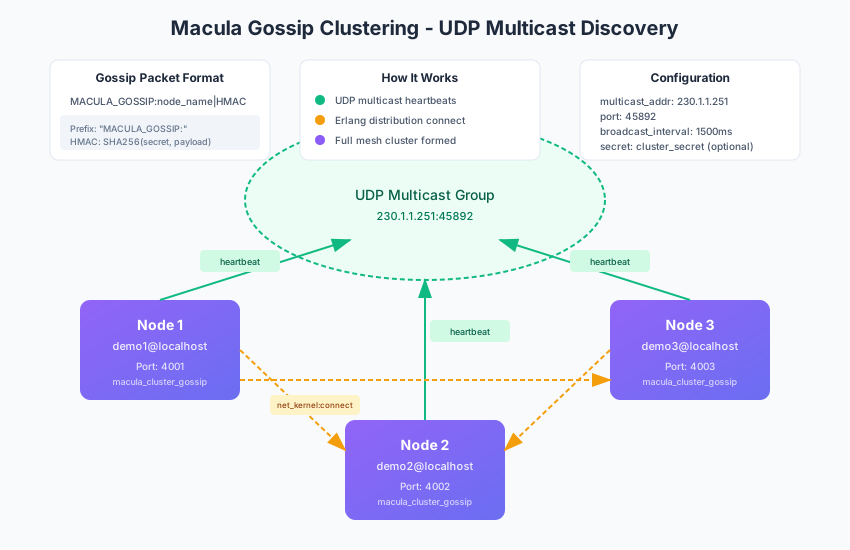
The macula_cluster_gossip module provides automatic cluster discovery using UDP multicast, implemented natively in Erlang.
How It Works
- Join Multicast Group: Each node joins the UDP multicast group (default:
230.1.1.251:45892) - Broadcast Heartbeats: Nodes periodically broadcast their Erlang node name
- Discover Peers: When a heartbeat is received from an unknown node, it's added to discovered set
- Connect via Distribution: Newly discovered nodes are connected using
net_kernel:connect_node/1 - Full Mesh: All nodes eventually connect to form a full mesh cluster
Configuration Options
| Option | Type | Default | Description |
|---|---|---|---|
multicast_addr | {A,B,C,D} | {230,1,1,251} | Multicast group address |
port | integer() | 45892 | UDP port for gossip |
broadcast_interval | integer() | 1500 | Milliseconds between heartbeats |
multicast_ttl | integer() | 1 | Time-to-live (1 = same subnet) |
secret | binary() | MACULA_GOSSIP_SECRET | Shared secret of at least 32 bytes. Required |
callback | pid() | {M,F} | undefined | Callback for cluster events |
Shared Secret
Gossip does not start without a shared secret of at least 32 bytes, given as
the secret option or in MACULA_GOSSIP_SECRET. start_link/1 then returns
{error, secret_required} or
{error, {secret_too_short, #{bytes => N, required => 32}}}, and
macula_cluster:start_cluster/1 returns either as
{error, {gossip_strategy_failed, Reason}}.
Every gossip packet carries an HMAC-SHA256 tag over the node name:
MACULA_GOSSIP:node_name|<HMAC-SHA256 in hex>A node takes a packet only when its tag verifies against the secret and the announced name is a node name whose host is a hostname, an IPv4 address or an IPv6 literal.
Environment Variables
MACULA_GOSSIP_ADDR=230.1.1.251
MACULA_GOSSIP_PORT=45892
MACULA_GOSSIP_SECRET=at-least-32-bytes-of-shared-secret
CLUSTER_STRATEGY=gossip
Gossip Query API
%% Get all discovered nodes (may not be connected yet)
Discovered = macula_cluster_gossip:get_discovered().

%% Get connected nodes
Connected = macula_cluster_gossip:get_connected().

%% Force immediate broadcast (useful for testing)
ok = macula_cluster_gossip:broadcast_now().
Distribution Management
Ensure Distributed Mode
ok = macula:ensure_distributed().If the node is already distributed, returns ok immediately. Otherwise, starts distribution with a generated node name in the format macula_host@hostname.
Cookie Management
macula sets no distribution cookie, and reads or writes no cookie file. A node's cookie is its release's own configuration, which OTP applies when distribution starts:
- The node reads
.erlang.cookiein theHOMEit started with. OTP refuses a cookie file its group or others can access, and creates an owner-only one (mode 0400) with a random cookie when there is none. - Nodes that form a cluster need the same cookie. Give each node the same cookie file, owned by the user the node runs as, with mode 0400 or 0600. In a container, mount it read-only at that user's
$HOME/.erlang.cookie. - A release that passes
-setcookieitself takes the cookie from wherever that flag gets it. Elixir'smix releasereads itsreleases/COOKIEfile, orRELEASE_COOKIEwhen that is set; prefer the file.
Keep the cookie out of environment variables and command lines: /proc/<pid>/environ, ps and docker inspect show them.
macula:get_cookie/0
Returns the running node's cookie, as erlang:get_cookie/0 does, and raises not_distributed on a node that is not distributed. Deprecated, and removed in 11.0.0: call erlang:get_cookie/0.
Cookie = macula:get_cookie().macula:set_cookie/1
Sets the cookie of the running node, and raises not_distributed on a node that is not distributed. It writes no file, so a restarted node has its cookie file's cookie again. Deprecated, and removed in 11.0.0: call erlang:set_cookie/1.
ok = macula:set_cookie(my_secret_cookie).
ok = macula:set_cookie(<<"my_secret_cookie">>).
Node Monitoring
Subscribe to Events
ok = macula:monitor_nodes().

receive
    {nodeup, Node} -> io:format("Node joined: ~p~n", [Node]);
    {nodedown, Node} -> io:format("Node left: ~p~n", [Node])
end.
Unsubscribe
ok = macula:unmonitor_nodes().Gossip-Specific Callbacks
%% Using a PID
{ok, _} = macula_cluster_gossip:start_link(#{callback => self(), secret => Secret}).

receive
    {macula_cluster, nodeup, Node} -> handle_join(Node);
    {macula_cluster, nodedown, Node} -> handle_leave(Node)
end.

%% Using module/function callback
{ok, _} = macula_cluster_gossip:start_link(#{
    callback => {my_module, handle_cluster_event},
    secret => Secret
}).
Docker Compose Example
services:
  node1:
    image: my-app:latest
    network_mode: host  # Required for UDP multicast
    environment:
      - RELEASE_NODE=node1@localhost
      - CLUSTER_STRATEGY=gossip

      - CLUSTER_SECRET=demo_secret
    volumes:
      # The shared cookie file, owned by the container's user, mode 0400.
      - ./erlang.cookie:/home/app/.erlang.cookie:ro
      - MACULA_GOSSIP_SECRET=${MACULA_GOSSIP_SECRET}  # at least 32 bytes, the same on every node

  node2:
    image: my-app:latest
    network_mode: host
    environment:
      - RELEASE_NODE=node2@localhost
      - CLUSTER_STRATEGY=gossip

      - CLUSTER_SECRET=demo_secret
    volumes:
      - ./erlang.cookie:/home/app/.erlang.cookie:ro
      - MACULA_GOSSIP_SECRET=${MACULA_GOSSIP_SECRET}  # at least 32 bytes, the same on every node
Network Requirements
Firewall Rules
# Allow UDP multicast traffic
iptables -A INPUT -p udp --dport 45892 -j ACCEPT
iptables -A OUTPUT -p udp --dport 45892 -j ACCEPT

# For Erlang distribution (EPMD and distribution ports)
iptables -A INPUT -p tcp --dport 4369 -j ACCEPT
iptables -A INPUT -p tcp --dport 9100:9200 -j ACCEPT
Docker Networking
Host Networking (Recommended for development):
network_mode: hostMacvlan (Production):
networks:
  macvlan_net:
    driver: macvlan
    driver_opts:
      parent: eth0
    ipam:
      config:
        - subnet: 192.168.1.0/24
Troubleshooting
Nodes Not Discovering Each Other
- Check multicast support:
ping -c 3 230.1.1.251 Verify UDP port is open:
ss -ulnp | grep 45892- Check Docker networking: Must use host networking for multicast
- Verify cookie matches:
erlang:get_cookie().
Authentication Failures
Nodes with different secrets drop each other's packets and never discover each
other; the dropped packets are logged at debug level. Ensure all nodes use the
same MACULA_GOSSIP_SECRET, or the same secret option.
Gossip Does Not Start
{error, secret_required} or {error, {secret_too_short, ...}} means the node
has no shared secret of at least 32 bytes. Set MACULA_GOSSIP_SECRET, or pass
secret.
High CPU Usage
If broadcast_interval is too low, increase it:
{ok, _} = macula_cluster_gossip:start_link(#{broadcast_interval => 5000, secret => Secret}).Security Best Practices
- Use a random shared secret - Gossip requires one of at least 32 bytes; generate it with, for example,
openssl rand -hex 32 - Rotate secrets periodically - Coordinate rotation across all nodes
- Use network segmentation - Limit multicast scope with VLANs
- Set TTL appropriately -
multicast_ttl => 1limits to same subnet
Testing
# Run gossip clustering tests
rebar3 eunit --module=macula_cluster_gossip_tests

# Run cluster API tests
rebar3 eunit --module=macula_cluster_tests

# Run full cluster test suite
rebar3 eunit --dir=test/macula_cluster_system
Related Documentation
- Dist Over Mesh Guide - WAN connectivity via relay mesh
- Erlang Distribution Protocol