Macula HTTP/3 Mesh - RPC Guide
View SourceComplete guide to RPC with DHT-based service discovery over the relay mesh
Status: ✅ COMPLETE Last Updated: 2025-01-10
Table of Contents
- Overview
- Architecture
- Service Advertisement
- Service Discovery
- Making RPC Calls
- Error Handling
- Performance Optimization
- Best Practices
- Examples
- Migration from WAMP
Overview
Macula provides relay-routed RPC without requiring any central registry or broker. Services advertise themselves via the relay mesh, and the Kademlia DHT between relays handles procedure discovery. Consumers discover providers by querying their relay, which routes lookups through the DHT.
Key Features
✅ Fully Decentralized - No central authority, DHT-based discovery ✅ Local-First Optimization - Zero-latency for local services ✅ Smart Caching - DHT results cached (60s TTL) to reduce queries ✅ Graceful Degradation - Continues operation when DHT unavailable ✅ Multiple Providers - Automatic load balancing across providers ✅ Fault Tolerant - Provider failover if one becomes unavailable ✅ NAT-Friendly - HTTP/3 QUIC works through firewalls
How It Works
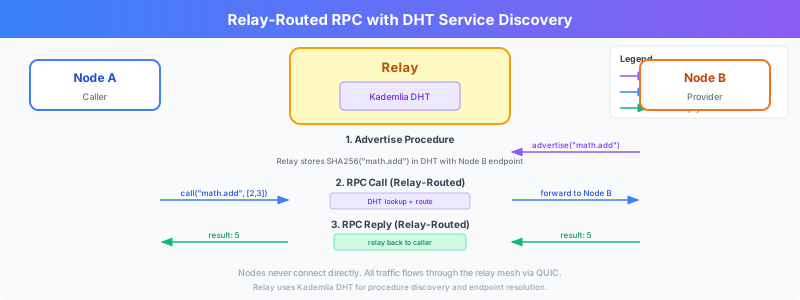
The diagram above illustrates the complete RPC flow:
- Discovery Hierarchy - 4-tier fallback: Local → Cache → DHT → Direct
- Service Advertisement - Providers register to local registry and DHT
- RPC Call Flow - Consumer discovers provider, sends MSG_CALL, receives MSG_REPLY
- Multi-Provider Load Balancing - Round-robin selection with automatic failover
Discovery Hierarchy
Macula uses a 4-tier fallback hierarchy for optimal performance:
- Local Handler ⚡ - Zero latency if service advertised locally
- Cache Hit 🚀 - Fast retrieval from local cache (60s TTL)
- DHT Query 🌐 - Query DHT for providers, cache result
- Direct Call 🔗 - Fallback to connected endpoint
This design ensures:
- Local calls have zero network overhead
- Cached discoveries are sub-millisecond
- DHT queries happen only on cache miss (every 60 seconds per service)
- System continues working even if DHT is unavailable
Architecture
Components
macula_service_registry
Core registry module that manages:
- Local services - Handler functions for services this node provides
- Discovery cache - Cached provider lists from DHT queries (60s TTL)
- DHT integration - Publish/query/remove operations
Key Functions:
advertise_local/4- Store handler locallyget_local_handler/2- Retrieve local handlerdiscover_service/2,3- Check cache for providerscache_service/4- Store DHT results in cachepublish_to_dht/5- Publish service to DHTquery_dht_for_service/3- Query DHT for providersremove_from_dht/3- Remove service from DHT
macula_connection
Connection gen_server that:
- Holds
service_registryin state - Handles
advertise,unadvertise,callrequests - Executes handlers in spawned processes (non-blocking)
- Sends
MSG_CALL,MSG_REPLY,MSG_ERRORmessages
macula (Public API)
The only module applications should import. Delegates to internal modules:
connect/2,connect_local/1- Connect to meshadvertise/3,4- Advertise a servicecall/3,4- Call a serviceunadvertise/2- Stop advertisingdisconnect/1- Close connection
macula_peer (Internal)
Internal mesh participant module (called by macula).
macula_routing_dht
DHT implementation (Kademlia):
- Pure functional DHT operations
- K-bucket routing table
- Store/find value operations
- K-value replication (typically 20)
Data Flow
Service Advertisement:
Application
   ↓
macula:advertise(Client, Procedure, Handler, Opts)
   ↓
macula_connection (gen_server:call)
   ↓
macula_service_registry:advertise_local(Registry, Procedure, Handler, Metadata)
   ↓
macula_service_registry:publish_to_dht(DhtPid, Procedure, ProviderInfo, TTL, K)
   ↓
macula_routing_dht (DHT storage at key=SHA256(Procedure))
Service Discovery and Call:
Application
   ↓
macula:call(Client, Procedure, Args)
   ↓
macula_connection (gen_server:call)
   ↓
macula_service_registry:get_local_handler(Registry, Procedure)
   → Found? Execute locally (zero-latency path)
   ↓
macula_service_registry:discover_service(Registry, Procedure)
   → Cache hit? Use cached providers (fast path)
   ↓
macula_service_registry:query_dht_for_service(DhtPid, Procedure, K)
   → Query DHT, cache result
   ↓
Pick provider from list
   ↓
Send MSG_CALL over HTTP/3 QUIC to provider
   ↓
Provider executes handler → MSG_REPLY
   ↓
Application receives result
Storage
DHT Key: SHA256(Procedure) (32-byte key)
DHT Value:
#{
    node_id => binary(),         % 32-byte node identifier
    endpoint => binary(),        % Connection endpoint (e.g., <<"https://localhost:9443">>)
    metadata => map(),           % Custom metadata (version, description, etc.)
    advertised_at => integer(),  % Unix timestamp
    ttl => pos_integer()         % Seconds
}
Local Cache Entry:
#{
    service_id => binary(),
    providers => [ProviderInfo],
    cached_at => integer(),      % Unix timestamp
    ttl => 60                    % Seconds (hard-coded)
}
Service Advertisement
Basic Advertisement
%% Erlang
Handler = fun(Args) ->
    case Args of
        #{user_id := UserId} ->
            {ok, #{user_id => UserId, name => <<"Alice">>}};
        _ ->
            {error, invalid_args}
    end
end,

{ok, Ref} = macula:advertise(
    Client,
    <<"myapp.user.get">>,
    Handler
).
# Elixir
handler = fn
%{user_id: user_id} ->
{:ok, %{user_id: user_id, name: "Alice"}}
_ ->
{:error, :invalid_args}
end
{:ok, ref} = :macula.advertise(
client,
"myapp.user.get",
handler
)With Options
{ok, Ref} = macula:advertise(
    Client,
    <<"myapp.user.get">>,
    Handler,
    #{
        metadata => #{
            version => <<"1.0.0">>,
            description => <<"Fetch user by ID">>,
            capabilities => [<<"read">>]
        },
        ttl => 300  % 5 minutes
    }
).
Handler Function Contract
Handlers must follow this contract:
-type handler_fn() :: fun((Args :: map()) -> {ok, Result :: term()} | {error, Reason :: term()}).Rules:
- Input: Always a map (even if empty:
#{}) - Output: Tuple
{ok, Result}or{error, Reason} - Execution: Handlers run in spawned processes (non-blocking)
- Errors: Handler crashes are caught and returned as
{error, {handler_crash, Reason}}
TTL and Re-advertisement
Default TTL: 300 seconds (5 minutes)
Services must be re-advertised before TTL expiration to remain discoverable. Currently this is manual - future enhancement will add automatic periodic re-advertisement.
%% Manual re-advertisement pattern
re_advertise_loop(Client, Procedure, Handler, Opts) ->
    TTL = maps:get(ttl, Opts, 300),
    {ok, _Ref} = macula:advertise(Client, Procedure, Handler, Opts),

    %% Re-advertise every 4 minutes (before 5-minute TTL expires)
    timer:sleep((TTL - 60) * 1000),
    re_advertise_loop(Client, Procedure, Handler, Opts).
Unadvertising
ok = macula:unadvertise(Client, <<"myapp.user.get">>).Behavior:
- Removes local handler from service registry
- Attempts to remove from DHT (best-effort)
- DHT entries expire naturally via TTL anyway
Service Discovery
Service discovery happens automatically when calling a service via macula:call/2,3.
Discovery Flow
%% 1. Check local handler (zero-latency)
case macula_service_registry:get_local_handler(Registry, Procedure) of
    {ok, Handler} ->
        %% Execute locally - no network overhead
        Handler(Args);

    not_found ->
        %% 2. Check cache (fast path)
        case macula_service_registry:discover_service(Registry, Procedure) of
            {ok, Providers, Registry2} ->
                %% Cache hit - use cached providers
                pick_provider_and_call(Providers);

            {cache_miss, Registry2} ->
                %% 3. Query DHT (cache miss)
                case macula_service_registry:query_dht_for_service(DhtPid, Procedure, 20) of
                    {ok, Providers} when Providers =/= [] ->
                        %% Cache the result (60s TTL)
                        Registry3 = macula_service_registry:cache_service(
                            Registry2, Procedure, Providers, 60
                        ),
                        pick_provider_and_call(Providers);

                    {ok, []} ->
                        %% No providers found
                        {error, service_not_found};

                    {error, Reason} ->
                        %% DHT unavailable - fallback to direct call
                        direct_call_fallback()
                end
        end
end.
Force Refresh
Skip cache and force DHT query:
{ok, Result} = macula:call(
    Client,
    <<"myapp.user.get">>,
    #{user_id => <<"user-123">>},
    #{force_refresh => true}
).
Cache Management
Cache TTL: 60 seconds (hard-coded in macula_service_registry)
Pruning: Expired entries can be pruned manually:
{Registry2, RemovedCount} = macula_service_registry:prune_expired(Registry).Clearing: Clear all cache entries:
Registry2 = macula_service_registry:clear_cache(Registry).Making RPC Calls
Basic Call
%% Erlang
{ok, User} = macula:call(
    Client,
    <<"myapp.user.get">>,
    #{user_id => <<"user-123">>}
).
# Elixir
{:ok, user} = :macula.call(
client,
"myapp.user.get",
%{user_id: "user-123"}
)With Timeout
{ok, Result} = macula:call(
    Client,
    <<"slow.operation">>,
    #{data => SomeData},
    #{timeout => 30000}  % 30 seconds
).
Local-First Pattern
If a service is advertised locally, the call has zero network overhead:
%% Node A advertises service
{ok, _} = macula:advertise(Client, <<"calc.add">>, HandlerFn),

%% Node A calls the same service - executed locally (no network)
{ok, Result} = macula:call(Client, <<"calc.add">>, #{a => 10, b => 5}).
%% Result = #{result => 15}
This is extremely efficient for:
- Self-service calls
- Co-located services on the same node
- Testing and development
Error Handling
Error Types
-type call_error() ::
    timeout |                          % Call timed out
    service_not_found |                % No providers found in DHT
    {handler_error, Reason :: term()} | % Handler returned {error, Reason}
    {handler_crash, Reason :: term()} | % Handler process crashed
    {connection_error, Reason :: term()} | % Network error
    term().                            % Other errors
Comprehensive Error Handling
case macula:call(Client, Procedure, Args, #{timeout => 10000}) of
    {ok, Result} ->
        %% Success
        process_result(Result);

    {error, timeout} ->
        %% Call timed out after 10 seconds
        ?LOG_WARNING("RPC call timed out: ~s", [Procedure]),
        {error, timeout};

    {error, service_not_found} ->
        %% No providers found in DHT
        ?LOG_ERROR("Service not available: ~s", [Procedure]),
        {error, unavailable};

    {error, {handler_error, Reason}} ->
        %% Handler explicitly returned {error, Reason}
        ?LOG_WARNING("Handler error for ~s: ~p", [Procedure, Reason]),
        {error, {business_logic_error, Reason}};

    {error, {handler_crash, Reason}} ->
        %% Handler process crashed
        ?LOG_ERROR("Handler crashed for ~s: ~p", [Procedure, Reason]),
        {error, internal_error};

    {error, {connection_error, Reason}} ->
        %% Network/transport error
        ?LOG_ERROR("Connection error calling ~s: ~p", [Procedure, Reason]),
        {error, network_error};

    {error, Reason} ->
        %% Catch-all for other errors
        ?LOG_ERROR("Unexpected error calling ~s: ~p", [Procedure, Reason]),
        {error, unknown_error}
end.
Retry Pattern
call_with_retry(Client, Procedure, Args, MaxRetries) ->
    call_with_retry(Client, Procedure, Args, MaxRetries, 0).

call_with_retry(_Client, _Procedure, _Args, MaxRetries, Attempt)
        when Attempt >= MaxRetries ->
    {error, max_retries_exceeded};

call_with_retry(Client, Procedure, Args, MaxRetries, Attempt) ->
    case macula:call(Client, Procedure, Args, #{timeout => 5000}) of
        {ok, Result} ->
            {ok, Result};

        {error, timeout} ->
            %% Retry on timeout
            timer:sleep(1000 * (Attempt + 1)),  % Exponential backoff
            call_with_retry(Client, Procedure, Args, MaxRetries, Attempt + 1);

        {error, {connection_error, _}} ->
            %% Retry on connection errors
            timer:sleep(1000 * (Attempt + 1)),
            call_with_retry(Client, Procedure, Args, MaxRetries, Attempt + 1);

        {error, Reason} ->
            %% Don't retry on business logic errors
            {error, Reason}
    end.
Performance Optimization
Local-First Optimization
Zero-latency local calls:
- Local handlers checked first
- No network overhead if service advertised locally
- Ideal for co-located services
Caching Strategy
60-second cache TTL:
- DHT queries cached for 60 seconds
- Reduces DHT load
- Balances freshness vs performance
Cache hit ratio:
Cache Hit Ratio = (Cache Hits) / (Total Calls)

Example:
- Service called 100 times/minute
- Cache TTL = 60 seconds
- DHT queries = ~2/minute (every 60s)
- Cache hit ratio = 98%
DHT Query Optimization
Kademlia K-value: 20 (standard)
- Stores service advertisement on 20 nodes
- High availability even if nodes fail
- Fast lookups (log N hops)
SHA-256 Key Distribution:
- Deterministic key generation
- Even distribution across DHT keyspace
- Prevents hotspots
Provider Selection
Current: Simple first-provider selection
Future enhancements:
- Round-robin load balancing
- Random selection
- Least-loaded provider
- Geographic proximity
- Custom selection strategies
Graceful Degradation
DHT unavailable:
- Logs warning but continues
- Falls back to direct call to connected endpoint
- Local services still work
Network partitions:
- Each partition has local DHT
- Services discoverable within partition
- Automatic recovery when partition heals
Best Practices
Service Naming
Use hierarchical naming with dot-separated segments:
%% Good
<<"myapp.user.get">>
<<"energy.home.measure">>
<<"payment.invoice.create">>

%% Avoid
<<"get_user">>          % Not namespaced
<<"user">>              % Too generic
<<"user-get">>          % Use dots, not dashes
Handler Design
Keep handlers simple:
%% Good - simple, focused
Handler = fun(#{user_id := UserId}) ->
    case user_db:get(UserId) of
        {ok, User} -> {ok, User};
        not_found -> {error, not_found}
    end
end.

%% Avoid - complex logic in handler
Handler = fun(Args) ->
    %% Don't do heavy processing in handler
    %% Spawn workers if needed
    case Args of
        #{action := <<"create">>, data := Data} ->
            %% Heavy processing...
        #{action := <<"update">>, data := Data} ->
            %% More heavy processing...
        #{action := <<"delete">>, id := Id} ->
            %% Even more processing...
    end
end.
Pattern matching on function heads:
%% Good - separate functions for different actions
handle_get(#{user_id := UserId}) ->
    user_db:get(UserId).

handle_create(#{name := Name, email := Email}) ->
    user_db:create(Name, Email).

Handler = fun(Args) ->
    case Args of
        #{action := <<"get">>} -> handle_get(Args);
        #{action := <<"create">>} -> handle_create(Args);
        _ -> {error, invalid_action}
    end
end.
Metadata Usage
Include useful metadata:
#{
    metadata => #{
        version => <<"1.2.3">>,              % Semantic version
        description => <<"User management">>, % Human-readable description
        capabilities => [<<"read">>, <<"write">>], % What it can do
        schema => #{                         % Input/output schema
            input => [user_id],
            output => [user_id, name, email]
        }
    }
}
TTL Configuration
Choose TTL based on service characteristics:
%% Long-lived services (rarely change)
#{ttl => 3600}  % 1 hour

%% Normal services
#{ttl => 300}   % 5 minutes (default)

%% Dynamic services (frequently changing)
#{ttl => 60}    % 1 minute
Error Handling in Handlers
Always return proper error tuples:
Handler = fun(Args) ->
    try
        Result = do_work(Args),
        {ok, Result}
    catch
        error:{badmatch, _} ->
            {error, invalid_args};
        error:database_error ->
            {error, service_unavailable};
        Class:Reason ->
            ?LOG_ERROR("Handler crashed: ~p:~p", [Class, Reason]),
            {error, internal_error}
    end
end.
Monitoring
Log important events:
%% On advertisement
?LOG_INFO("Advertised service ~s with metadata ~p", [Procedure, Metadata]),

%% On DHT publish success/failure
?LOG_INFO("Published service ~s to DHT", [Procedure]),
?LOG_WARNING("Failed to publish service ~s to DHT: ~p", [Procedure, Reason]),

%% On service calls
?LOG_DEBUG("Calling service ~s with args ~p", [Procedure, Args]),
?LOG_INFO("Service ~s completed in ~p ms", [Procedure, Duration]).
Examples
Example 1: Calculator Service
%% calculator_service.erl
-module(calculator_service).
-export([start/1, advertise/1]).

start(Client) ->
    Handler = fun(Args) ->
        case Args of
            #{operation := <<"add">>, a := A, b := B} ->
                {ok, #{result => A + B}};
            #{operation := <<"subtract">>, a := A, b := B} ->
                {ok, #{result => A - B}};
            #{operation := <<"multiply">>, a := A, b := B} ->
                {ok, #{result => A * B}};
            #{operation := <<"divide">>, a := A, b := 0} ->
                {error, division_by_zero};
            #{operation := <<"divide">>, a := A, b := B} ->
                {ok, #{result => A / B}};
            _ ->
                {error, invalid_operation}
        end
    end,

    macula:advertise(
        Client,
        <<"calculator.compute">>,
        Handler,
        #{metadata => #{version => <<"1.0.0">>}}
    ).

%% Client code
{ok, Client} = macula:connect(<<"https://localhost:9443">>, #{}),
{ok, _Ref} = calculator_service:advertise(Client),

%% Make calls
{ok, #{result := 15}} = macula:call(
    Client, <<"calculator.compute">>,
    #{operation => <<"add">>, a => 10, b => 5}
).
Example 2: User Service with Database
%% user_service.erl
-module(user_service).
-export([start/1]).

start(Client) ->
    Handler = fun(Args) ->
        handle_request(Args)
    end,

    macula:advertise(
        Client,
        <<"users.manage">>,
        Handler,
        #{
            metadata => #{
                version => <<"2.0.0">>,
                capabilities => [<<"read">>, <<"write">>, <<"delete">>]
            },
            ttl => 300
        }
    ).

handle_request(#{action := <<"get">>, user_id := UserId}) ->
    case user_db:fetch(UserId) of
        {ok, User} -> {ok, User};
        not_found -> {error, user_not_found}
    end;

handle_request(#{action := <<"create">>, name := Name, email := Email}) ->
    case user_db:create(#{name => Name, email => Email}) of
        {ok, UserId} ->
            {ok, #{user_id => UserId, name => Name, email => Email}};
        {error, Reason} ->
            {error, Reason}
    end;

handle_request(#{action := <<"delete">>, user_id := UserId}) ->
    case user_db:delete(UserId) of
        ok -> {ok, #{status => <<"deleted">>}};
        {error, Reason} -> {error, Reason}
    end;

handle_request(_) ->
    {error, invalid_action}.
Example 3: Multi-Provider Discovery
%% Provider Node 1
{ok, Client1} = macula:connect(<<"https://node1:9443">>, #{}),
{ok, _} = macula:advertise(Client1, <<"weather.get">>, Handler1),

%% Provider Node 2
{ok, Client2} = macula:connect(<<"https://node2:9443">>, #{}),
{ok, _} = macula:advertise(Client2, <<"weather.get">>, Handler2),

%% Consumer Node
{ok, Client3} = macula:connect(<<"https://node3:9443">>, #{}),

%% Call service - DHT returns both providers
%% One is selected automatically
{ok, Weather} = macula:call(
    Client3,
    <<"weather.get">>,
    #{city => <<"Brussels">>}
).
Example 4: Elixir Phoenix Application
# lib/my_app/macula_rpc.ex
defmodule MyApp.MaculaRPC do
  use GenServer

  def start_link(opts) do
    GenServer.start_link(__MODULE__, opts, name: __MODULE__)
  end

  def init(_opts) do
    {:ok, client} = :macula.connect("https://localhost:9443", %{
      realm: "com.myapp"
    })

    # Advertise multiple services
    advertise_services(client)

    {:ok, %{client: client}}
  end

  defp advertise_services(client) do
    # User service
    user_handler = fn
      %{action: "get", user_id: user_id} ->
        case MyApp.Users.get(user_id) do
          {:ok, user} -> {:ok, user}
          _ -> {:error, :not_found}
        end

      %{action: "create", params: params} ->
        case MyApp.Users.create(params) do
          {:ok, user} -> {:ok, user}
          {:error, changeset} -> {:error, {:validation, changeset}}
        end
    end

    :macula.advertise(client, "myapp.users", user_handler, %{
      metadata: %{version: "1.0.0", description: "User management"}
    })

    # Post service
    post_handler = fn args -> MyApp.Posts.handle_rpc(args) end

    :macula.advertise(client, "myapp.posts", post_handler, %{
      metadata: %{version: "1.0.0"}
    })
  end

  # Client wrapper
  def call(procedure, args, opts \\ %{}) do
    client = GenServer.call(__MODULE__, :get_client)
    :macula.call(client, procedure, args, opts)
  end

  def handle_call(:get_client, _from, %{client: client} = state) do
    {:reply, client, state}
  end
end

# Usage in Phoenix controller
defmodule MyAppWeb.UserController do
  use MyAppWeb, :controller

  def show(conn, %{"id" => id}) do
    case MyApp.MaculaRPC.call("myapp.users", %{action: "get", user_id: id}) do
      {:ok, user} ->
        json(conn, user)

      {:error, :not_found} ->
        conn
        |> put_status(:not_found)
        |> json(%{error: "User not found"})

      {:error, reason} ->
        conn
        |> put_status(:internal_server_error)
        |> json(%{error: inspect(reason)})
    end
  end
end
Migration from WAMP
Key Differences
| Aspect | WAMP (Bondy) | Macula HTTP/3 |
|---|---|---|
| Discovery | Centralized registry | DHT-based (decentralized) |
| Transport | WebSocket | HTTP/3 QUIC |
| Registration | session.register(Procedure, Handler) | macula:advertise(Client, Procedure, Handler) |
| RPC Call | session.call(Procedure, Args) | macula:call(Client, Procedure, Args) |
| Unregister | session.unregister(Registration) | macula:unadvertise(Client, Procedure) |
| Handler Args | [Args, Kwargs] (positional + keyword) | Args :: map() (map only) |
| NAT Traversal | Requires special config | Built-in (QUIC) |
Migration Steps
1. Update Dependencies
%% Before (WAMP)
{deps, [
    {bondy, {git, "https://github.com/bondy-io/bondy.git", {tag, "1.0.0"}}}
]}.

%% After (Macula)
{deps, [
    {macula, "0.6.6"}
]}.
2. Convert Registration
%% Before (WAMP)
Handler = fun([Args, Kwargs]) ->
    UserId = proplists:get_value(<<"user_id">>, Kwargs),
    {ok, #{user_id => UserId, name => <<"Alice">>}}
end,
{ok, Registration} = bondy:register(Session, <<"myapp.user.get">>, Handler).

%% After (Macula)
Handler = fun(Args) ->
    #{user_id := UserId} = Args,
    {ok, #{user_id => UserId, name => <<"Alice">>}}
end,
{ok, Ref} = macula:advertise(Client, <<"myapp.user.get">>, Handler).
3. Convert RPC Calls
%% Before (WAMP)
{ok, Result} = bondy:call(Session, <<"myapp.user.get">>, [#{user_id => <<"123">>}]).

%% After (Macula)
{ok, Result} = macula:call(Client, <<"myapp.user.get">>, #{user_id => <<"123">>}).
4. Update Handler Signatures
%% Before (WAMP) - separate positional and keyword args
Handler = fun([PositionalArgs, KeywordArgs]) ->
    UserId = proplists:get_value(<<"user_id">>, KeywordArgs),
    %% ...
end.

%% After (Macula) - single map argument
Handler = fun(Args) ->
    #{user_id := UserId} = Args,
    %% ...
end.
5. Update Error Handling
%% Before (WAMP)
case bondy:call(Session, Procedure, Args) of
    {ok, Result} -> handle_result(Result);
    {error, {wamp_error, Uri, Details, _Args}} -> handle_wamp_error(Uri)
end.

%% After (Macula)
case macula:call(Client, Procedure, Args) of
    {ok, Result} -> handle_result(Result);
    {error, timeout} -> handle_timeout();
    {error, service_not_found} -> handle_not_found();
    {error, {handler_error, Reason}} -> handle_business_error(Reason)
end.
Migration Checklist
- [ ] Update dependencies (WAMP → Macula)
- [ ] Convert handler signatures (
[Args, Kwargs]→Args :: map()) - [ ] Replace
bondy:register/3withmacula:advertise/3,4 - [ ] Replace
bondy:call/3withmacula:call/2,3 - [ ] Replace
bondy:unregister/2withmacula:unadvertise/2 - [ ] Update error handling patterns
- [ ] Add periodic re-advertisement logic (if needed)
- [ ] Test with DHT unavailable (graceful degradation)
- [ ] Update monitoring and logging
See Also
- Quick Start Guide - Getting started tutorial
- PubSub Guide - Pub/Sub patterns and usage
- Glossary - Terminology reference
Last Updated: 2025-11-30 Status: ✅ Complete